

The Evolving Role of the Variable Frequency Drive

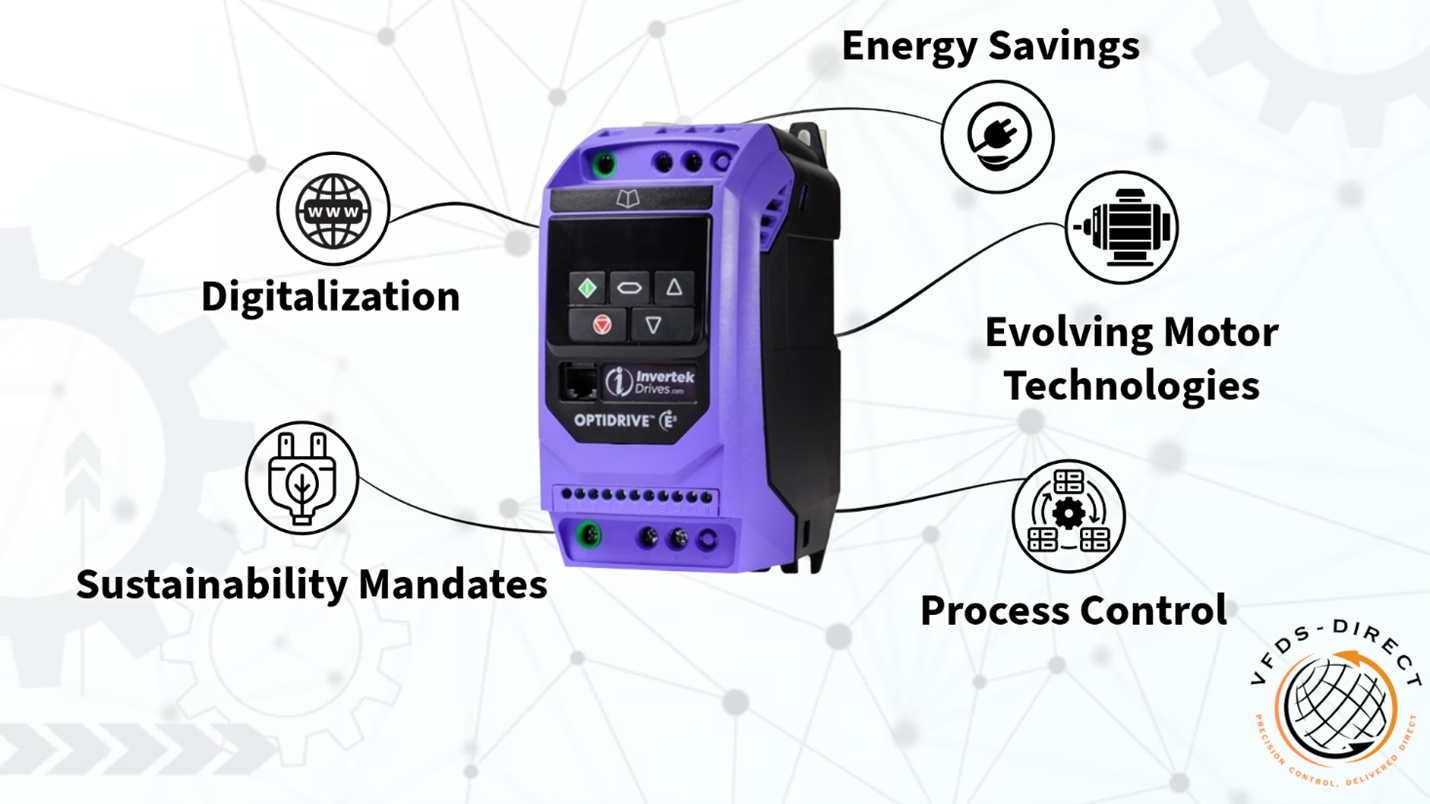
For many engineers, the role of a variable frequency drive (VFD) has long been clear: adjust motor speed, save energy, improve process control. But as we enter a new era of automation—marked by digitalization, sustainability mandates, and evolving motor technologies, the expectations of what a VFD can and should do are shifting.
At VFDs‑Direct.com, we believe the current moment presents a pivotal opportunity: to move from “just a drive” to a fully smart motor‑control node—and herein lies the competitive edge for design engineers, OEMs, and panel builders alike.
Let’s explore some trends changing the VFD market:
Trend 1: Energy Efficiency & Regulatory Drivers
The global VFD market is expected to grow from $28 billion in 2024 to nearly $40 billion by 2030—a CAGR of about 5.9%.
Industrial motor systems remain among the largest consumers of electrical energy, and governments worldwide are emphasizing carbon reduction and lifecycle efficiency over simple capex savings.
That means VFDs are now central to energy audits and continuous improvement plans rather than optional upgrades.
Engineering implication:
When specifying drives, look beyond V/Hz curves. Consider system-level efficiency, variable load optimization (especially for pumps/fans), and compliance with tightening efficiency standards.
Trend 2: Smart / Connected Drives & IIoT Integration
Perhaps the most significant change is how drives now live inside networked, data-rich environments. Modern VFDs are expected to do far more than control motor speed — they’re part of the Industrial Internet of Things (IIoT).
Emerging features include:
- Real-time motor and drive health monitoring (temperature, vibration, harmonics)
- Predictive diagnostics and cloud connectivity
- Common DC-bus or regenerative topologies for multi-drive systems
Engineering implication:
When designing a panel today, ask:
Can this drive share data across our plant network? Can it support predictive maintenance? Can it optimize across multiple loads?
Smart drives are becoming sensors, not just controllers.
Trend 3: Motor + Drive Co-Evolution
Motor technology is rapidly advancing beyond traditional induction designs. High-efficiency permanent magnet (PM) and synchronous reluctance motors now require VFDs to operate efficiently.
We’re also seeing the rise of integrated motor-drive assemblies, decentralized drives mounted near motors, and modular DC-bus systems that enable more compact, flexible installations.
Engineering implication:
Treat the VFD as part of a holistic motor system—factor in compatibility, harmonics, EMI, and regenerative capabilities. The motor-drive pair determines overall system performance, not just the drive itself.
Trend 4: Application Expansion & System Optimization
Traditional VFD applications like fans and conveyors continue to dominate—but innovation is booming in niche and retrofit applications.
Key areas:
- Pump systems that use embedded logic for lead/lag control and diagnostics
- Medium-voltage drives for water, mining, and heavy industries
- Retrofit projects focusing on performance improvement rather than replacement
Engineering implication:
Designs that view the system holistically—load profile, energy audit, and payback period—deliver better long-term results than simple speed control implementations.
Trend 5: Supply Chain & Sustainability Pressures
Even component-level choices are being shaped by global sustainability and supply chain constraints.
Emerging realities:
- SiC and GaN semiconductors enable smaller, cooler, more efficient drives
- Compact, IP55-rated drives are ideal for decentralized or outdoor use
- Sustainable materials and recyclability are becoming selling points for OEMs
Engineering implication:
When selecting drives, evaluate lifecycle cost, cooling method, harmonic compliance, and manufacturer serviceability—not just upfront price.
What This Means for Electrical Engineers
Here are a few actionable takeaways for modern system designers:
- Start with the system, not the spec. Evaluate load variability, duty cycle, and network integration early.
- Specify for connectivity. Ethernet, Modbus, and OPC UA-ready drives provide future-proof flexibility.
- Plan for retrofit. Many existing systems can see huge gains with modern VFD replacements.
- Pair smartly. Choose drives compatible with high-efficiency motor types.
- Think lifecycle. Long-term energy savings and uptime justify premium drive features.
Conclusion
For electrical engineers and system designers, the VFD is no longer just a piece of hardware, it is a strategic building block in the evolution of intelligent automation.
At VFDs-Direct.com, we’re here to help engineers design, specify, and source drives that meet the new demands of performance, connectivity, and sustainability.
Let’s move beyond basic speed control and engineer the next generation of smart motor systems—together.